Every book is a conversation
AI-powered summaries, voice Q&A, debate panels, and spaced-repetition flashcards. Learn more from every book you pick up.

AI-powered summaries, voice Q&A, debate panels, and spaced-repetition flashcards. Learn more from every book you pick up.
Personalized to You
See how BookOne tailors The Art of War to two completely different goals.
The Art of War — Sun Tzu
The Art of War: Strategic Principles for Modern Life
The Art of War, written by Chinese military strategist Sun Tzu over 2,500 years ago, remains one of history's most influential texts on strategy, conflict, and leadership. While originally a military treatise, its principles have transcended warfare to become essential frameworks for business, personal development, and habit formation. For those focused on building better habits around productivity, health, and mindset, Sun Tzu's wisdom offers a systematic approach to self-mastery through strategic thinking.
Core Thesis: Victory Through Strategic Positioning
Sun Tzu's central premise is deceptively simple: the supreme art of war is to subdue the enemy without fighting. True victory comes not from brute force but from superior positioning, preparation, and strategic advantage. Applied to personal development, this means designing your environment, routines, and systems so that good habits become inevitable while bad habits become difficult.
The text emphasizes that all warfare is based on deception—not in a malicious sense, but in understanding that perception shapes reality. When building habits, this translates to managing your own psychology: making healthy choices appear easy and immediately rewarding while making destructive choices seem difficult and undesirable.
Know Yourself, Know Your Enemy
Sun Tzu's most famous principle states: "If you know the enemy and know yourself, you need not fear the result of a hundred battles." In the context of habit formation, "the enemy" represents the obstacles, temptations, and internal resistance that sabotage your goals.
Self-knowledge is the foundation of all lasting change. You must honestly assess your current capabilities, weaknesses, and behavioral patterns. Track when you're most vulnerable to breaking habits—is it during stress, after work, or on weekends? Understand your energy cycles, decision-making capacity, and emotional triggers. This intelligence gathering phase is not optional; it's the reconnaissance that determines strategic success.
Equally important is understanding your "enemy"—the friction points that derail progress. Is procrastination your weakness? Social pressure? Environmental cues? Sun Tzu teaches that victory is secured before battle begins, through preparation that addresses these challenges preemptively.
Strategic Planning and Calculation
The opening chapter emphasizes detailed planning and calculation before taking action. Sun Tzu identifies five fundamental factors: the moral law (purpose), heaven (timing), earth (environment), the commander (self-leadership), and method/discipline (systems).
For habit builders, this framework demands:
Purpose alignment: Your habits must connect to deeply held values. Why do you want to wake early, exercise, or read daily? Shallow motivations crumble under pressure; deep purpose sustains effort. Sun Tzu warns that campaigns without clear objectives waste resources—similarly, habits without meaningful purpose rarely stick.
Timing considerations: There are favorable and unfavorable seasons for change. Attempting to overhaul your entire life during maximum stress is strategic folly. Choose your moments wisely, attacking when conditions support success.
Environmental design: Sun Tzu repeatedly emphasizes adapting to terrain. Your physical and social environment either supports or undermines your habits. Place running shoes by your bed, remove junk food from your home, and surround yourself with people whose habits you wish to emulate. The wise general chooses battlegrounds that favor victory.
Speed and Decisiveness
While emphasizing preparation, Sun Tzu equally values swift execution once the moment arrives. "In war, then, let your great object be victory, not lengthy campaigns." Overthinking and perpetual planning are forms of defeat. Once you've strategized, commit fully and act immediately.
This principle combats analysis paralysis in habit formation. You don't need the perfect morning routine, the optimal diet plan, or complete motivation before starting. Begin with decisive action, adjust based on results, and maintain momentum. Sun Tzu notes that prolonged campaigns dull enthusiasm and drain resources—similarly, waiting for "the right time" to build habits ensures that time never comes.
Economy of Force
A recurring theme is efficiency and avoiding unnecessary expenditure of resources. Sun Tzu advises against lengthy sieges and recommends rapid, decisive victories. Applied to habits, this means: don't rely on willpower-intensive approaches. Willpower is a depleting resource.
Instead, design low-friction systems that make good habits the path of least resistance. Batch-cook healthy meals rather than resisting junk food daily. Automate savings transfers instead of depending on monthly discipline. Use implementation intentions ("if-then" plans) to bypass decision fatigue. The skilled strategist wins through positioning, not through exhausting effort.
Adaptability and Formlessness
Sun Tzu teaches that "water shapes its course according to the nature of the ground; the soldier works out his victory in relation to the foe." Rigid plans break; flexible strategies endure. Your habit systems must adapt to changing circumstances while maintaining core principles.
When traveling disrupts your gym routine, switch to bodyweight exercises. When work stress eliminates meditation time, practice mindful breathing during commutes. The master strategist has no fixed plan but responds fluidly to conditions. Build habits with built-in flexibility, so temporary disruptions don't become permanent derailments.
Consolidating Victories
Sun Tzu warns against overextension: "There is no instance of a nation benefiting from prolonged warfare." In habit terms, attempting too many changes simultaneously guarantees failure. Master one habit before adding another. Consolidate small wins into sustainable routines before expanding your campaign.
Celebrate progress and reinforce successful patterns. Sun Tzu emphasizes rewarding troops—similarly, acknowledge your victories and use them as fuel for continued growth. Each successful day strengthens your strategic position for the next.
Leadership and Self-Command
The text extensively discusses qualities of effective commanders: wisdom, sincerity, benevolence, courage, and strictness. These apply directly to self-leadership. Be honest about failures, compassionate with setbacks, courageous in commitment, and disciplined in execution.
Sun Tzu warns that success depends equally on opportunity and preparation meeting. You cannot control all circumstances, but you can ensure you're ready when favorable conditions arise. Build habits during easier seasons so you're resilient during harder ones.
Practical Applications
To apply Sun Tzu's principles to habit formation:
Conduct reconnaissance: Track current behaviors for one week without judgment
Identify strategic objectives: Choose one keystone habit aligned with core values
Assess terrain: Design your environment to support success
Plan the campaign: Create if-then implementation intentions
Strike decisively: Begin immediately with committed action
Adapt tactics: Adjust based on results, maintaining strategic flexibility
Consolidate gains: Master one habit before expanding
The Art of War ultimately teaches that mastery comes through strategic thinking, not motivational intensity. Build systems that make success inevitable, understand yourself deeply, adapt flexibly to conditions, and consolidate victories before advancing. As Sun Tzu promises: "The general who wins makes many calculations before the battle. The general who loses makes few." Your habits deserve the same strategic attention.
Listen to the full summary
Key Takeaways
Conduct a weekly personal audit: identify one habit that's working well (your strength) and one that's sabotaging your goals (your weakness). Track the specific triggers and environments that activate both. Use this intelligence to design your week—reinforcing strengths and removing obstacles that trigger weaknesses.
Engineer your environment to make good habits automatic and bad habits difficult. Place your workout clothes by your bed the night before. Delete social media apps from your phone. Prep healthy meals on Sunday. The goal is to remove daily decisions and friction—your productivity and health habits should feel like the path of least resistance.
Stop waiting for Monday, the new year, or the 'perfect moment' to start your habit. Identify the smallest possible version of your desired habit (2 push-ups, 1 page of reading, 5 minutes of meditation) and do it within the next 2 hours. Momentum beats perfection. Build consistency first, then scale intensity.
Apply the 80/20 rule to your habit stack: identify the 1-2 keystone habits that will create the most cascading benefits in your life (like sleep quality or daily exercise). Focus exclusively on mastering these for 30 days before adding anything else. Say 'no' to productivity hacks and habit challenges that don't directly support these priorities.
Create 'if-then' contingency plans for your habits. If you're traveling, then you'll do a 7-minute hotel room workout. If you're exhausted, then you'll do the 5-minute version of your routine. If you miss a day, then you'll restart immediately without guilt. Build flexibility into your system so disruptions don't derail you entirely.
When you identify a habit you want to start, implement it immediately in micro-form. Don't research for weeks or buy expensive equipment first. Want to start journaling? Write three sentences tonight in your phone. Want to exercise? Do 10 jumping jacks right now. Capture momentum before your mind creates resistance through overthinking.
Create identity-based rules rather than goal-based ones. Instead of 'I want to exercise 3x per week,' decide 'I am someone who moves their body daily.' Then establish a minimum viable version (10-minute walk counts). Track completion with a simple check mark on a calendar. Never miss twice—this is your non-negotiable discipline standard.
Practice 'strategic invisibility' for bad habits: keep junk food out of the house entirely (not in a drawer), use website blockers during deep work hours, and keep your phone in another room while sleeping. Simultaneously, make good habits obvious: place a book on your pillow, put vitamins next to your coffee maker, set out your journal with a pen on your desk.
Design your habits using the 'two-minute rule'—make the starting version so easy it's impossible to fail. Want to read more? Commit to one page per night. Want to meditate? Start with three conscious breaths. Track these micro-wins daily for 30 days. The identity shift from these consistent tiny victories will naturally lead to scaling up.
Track one habit metric objectively for 14 days: actual hours slept (use an app), actual servings of vegetables eaten, actual minutes of focused work (time-tracked), or actual days you completed your target behavior. Use data, not memory or feelings. This honest baseline reveals the truth about where you are and makes improvement measurable and real.
"The Art of War" by Sun Tzu is an ancient Chinese military treatise dating from the 5th century BC that has become one of the most influential strategy texts in history. While written for military commanders, its principles have been widely adapted to business strategy, entrepreneurship, competitive analysis, and organizational leadership. For entrepreneurs and business leaders, this classic offers timeless wisdom on competitive strategy, resource allocation, timing, and the psychology of competition.
Core Thesis
Sun Tzu's fundamental philosophy centers on winning without fighting—achieving victory through superior strategy, preparation, and understanding rather than direct confrontation. He argues that the supreme art of war is to subdue the enemy without battle, which translates directly to business: the best competitive strategy is one that achieves market dominance while minimizing costly battles that drain resources. This approach emphasizes strategic thinking over brute force, intelligence over ignorance, and adaptability over rigidity.
The text is organized into thirteen chapters, each addressing different aspects of strategy and warfare. For entrepreneurs, the most applicable concepts revolve around competitive positioning, strategic planning, resource management, market intelligence, and organizational leadership.
Strategic Planning and Preparation
Sun Tzu emphasizes that "every battle is won before it is fought" through meticulous planning and preparation. For entrepreneurs, this means conducting thorough market research, competitive analysis, and resource assessment before launching ventures. He introduces the concept of "calculating chances"—systematically evaluating factors that contribute to success or failure.
The five constant factors that determine victory are: the Way (shared mission and values), Heaven (timing and market conditions), Earth (terrain or market landscape), Command (leadership), and Method (organizational structure and processes). Entrepreneurs must assess all five before committing resources. A startup with excellent leadership and processes but poor market timing will likely fail, just as a business entering the right market at the right time but lacking organizational coherence will struggle.
Sun Tzu warns that prolonged campaigns drain resources and that speed is essential. In business terms, this translates to avoiding lengthy battles that exhaust capital and momentum. Entrepreneurs should seek decisive competitive advantages rather than engaging in protracted price wars or marketing battles that benefit no one. The principle of "rapidity" suggests that speed to market, quick decision-making, and agile execution create competitive advantages.
Competitive Strategy and Positioning
One of Sun Tzu's most famous principles is "know your enemy and know yourself; in a hundred battles you will never be defeated." For entrepreneurs, this means conducting rigorous competitive analysis while honestly assessing your own strengths and weaknesses. Many startups fail because they either underestimate competitors or overestimate their own capabilities.
Sun Tzu advocates for attacking weaknesses rather than strengths. In business, this means identifying market gaps, underserved customer segments, or areas where competitors are vulnerable rather than competing head-on in their strongest domains. A new entrant shouldn't directly challenge an established player's core competency but should instead find angles where they're weak or inattentive.
The concept of "shaping the opponent" is particularly relevant. Sun Tzu describes forcing the enemy to respond to your moves, expending their resources while preserving yours. In business, this translates to setting the competitive agenda—defining market categories, establishing new standards, or creating narratives that favor your strengths. First movers and category creators often shape how competitors must respond.
Resource Management and Efficiency
Sun Tzu repeatedly emphasizes that war is a matter of vital importance to the state and that resources must be used judiciously. For startups with limited capital, this principle is existential. He advocates for living off the enemy's resources—in business terms, this might mean partnering strategically, using competitors' infrastructure, or leveraging existing distribution channels rather than building everything from scratch.
The text warns against prolonged operations that strain the treasury. Entrepreneurs should avoid capital-intensive approaches when leaner alternatives exist. Sun Tzu would likely endorse modern concepts like lean startup methodology, minimum viable products, and bootstrapping when appropriate. The goal is achieving objectives with minimum resource expenditure.
Intelligence and Market Information
Sun Tzu devotes an entire chapter to espionage, emphasizing that foreknowledge cannot be obtained from ghosts and spirits but must come from people who know the enemy's situation. In business, this translates to market intelligence, customer research, and competitive monitoring. Entrepreneurs must invest in understanding customer needs, tracking competitor moves, and identifying market trends.
He identifies five types of spies, which can be adapted to business intelligence gathering: local (customers and market participants), inward (competitor employees who provide information), converted (leveraging competitors' own information against them), expendable (false information deliberately leaked), and living (returning with information). While corporate espionage is unethical and illegal, the underlying principle emphasizes that superior information creates strategic advantages.
Adaptability and Opportunism
Sun Tzu stresses that strategy must be fluid and adaptable: "water shapes its course according to the ground; an army manages victory according to the enemy." For entrepreneurs, this means avoiding rigid business plans that don't accommodate changing market conditions. Successful companies pivot when necessary, responding to customer feedback, competitive dynamics, and market evolution.
The text emphasizes exploiting opportunities when they arise. Sun Tzu describes waiting for the moment when the enemy makes mistakes or becomes vulnerable. In business, this might mean launching when a competitor stumbles, entering markets during industry transitions, or capitalizing on technological shifts that create openings.
Leadership and Organizational Management
Sun Tzu identifies five dangerous faults in a general that apply directly to entrepreneurs: recklessness (leading to destruction), cowardice (leading to capture), quick temper (leading to manipulation), delicacy of honor (leading to shame-based decisions), and over-solicitude for people (leading to worry and trouble). Entrepreneurs must balance confidence with caution, compassion with decisiveness, and pride with pragmatism.
Effective leadership requires understanding when to delegate and when to maintain control. Sun Tzu warns against sovereign interference in military operations, suggesting leaders should empower capable managers rather than micromanaging. For founders, this means hiring talented people and trusting them to execute while maintaining strategic oversight.
Practical Applications for Entrepreneurs
For those starting or growing businesses, "The Art of War" offers several actionable frameworks:
Pre-launch: Conduct thorough competitive and market analysis before committing resources. Assess timing, competitive landscape, your capabilities, and organizational readiness. Don't launch until conditions favor success.
Positioning: Identify and attack competitor weaknesses rather than competing where they're strongest. Find underserved niches, overlooked customer segments, or new market categories.
Resource allocation: Minimize expensive, prolonged battles. Seek decisive advantages and quick wins. Preserve resources for critical moments.
Intelligence: Invest in market research, customer understanding, and competitive monitoring. Superior information creates strategic options.
Adaptability: Remain flexible in execution while maintaining strategic clarity. Pivot when market conditions change or better opportunities emerge.
Timing: Recognize that entering markets too early or too late both create disadvantages. Strike when conditions are optimal.
Sun Tzu's ultimate lesson for entrepreneurs is that sustainable competitive advantage comes from strategic thinking, not just hard work or resources. The companies that thrive are those that outthink competitors, position themselves advantageously, move decisively when opportunities arise, and avoid costly battles that deplete their strength. In an era of rapid change and intense competition, these ancient principles remain remarkably relevant for modern business builders.
Listen to the full summary
Key Takeaways
Before launching a new product or entering a market, conduct a comprehensive SWOT analysis of your business and competitive intelligence research on at least your top 3 competitors. Create a matrix comparing your capabilities, resources, and positioning against theirs, then identify specific gaps where you have sustainable advantages to exploit.
Identify an underserved niche or create a new category where you can be the obvious choice rather than one of many options. Use Blue Ocean Strategy techniques to find where you can offer unique value combinations that make traditional competitors irrelevant—don't compete on their terms, change the game entirely.
Implement a 'bias for action' culture where you launch minimum viable products quickly to test market response rather than perfecting offerings in isolation. Set a rule: if you can get to market 60-70% ready, launch and iterate based on real customer feedback rather than waiting for 100% perfection that may miss the market timing.
Identify the one channel, customer segment, or product feature that will make the biggest difference to your business in the next 90 days. Allocate 70-80% of your resources to dominating that single area, deliberately saying 'no' to other opportunities. Once you've won decisively there, move to the next critical point.
Institute monthly strategy review sessions where you explicitly examine assumptions in your business plan against real-world results. Create a 'kill criteria' document listing specific metrics or conditions that would trigger a pivot, and commit to making changes when those thresholds are met rather than persisting with a failing approach.
Map out 5-10 potential partners who serve your target customer but don't compete directly with you. Reach out with specific collaboration proposals that create win-win value—co-marketing campaigns, technology integrations, or bundled offerings. Focus on partnerships where 1+1=3, creating value neither could achieve alone.
Before launching your most important strategic initiative, create a 'competitor response plan' that anticipates how rivals will react and how you'll maintain advantage. Consider soft-launching in secondary markets first to refine your approach before alerting major competitors, or conversely, announce boldly early to freeze competitor investment in alternative approaches.
Before seeking major funding or launching aggressive customer acquisition, ensure your business fundamentals are sound: customer acquisition cost is at least 3x lower than lifetime value, retention rates are strong, and core operations can scale. Create a 'readiness checklist' of 10 critical metrics that must be green before you 'step on the gas' with growth investments.
Break your ambitious long-term vision into a sequence of achievable 90-day milestones that each represent a meaningful, measurable win. Celebrate and publicize each victory to build team confidence and market credibility. Structure your roadmap so early wins generate resources (revenue, attention, talent) that fund subsequent, larger battles.
For each major initiative, define upfront what success looks like and set a time limit for achieving meaningful traction (typically 3-6 months). If you're not seeing clear progress by that deadline, have the discipline to cut losses and redeploy resources to more promising opportunities rather than continuing to invest in struggles that drain your runway without proportional returns.
Get AI-generated audio summaries with chapter breakdowns, key takeaways, and actionable insights. Perfect for busy readers who want the core ideas without the time commitment.
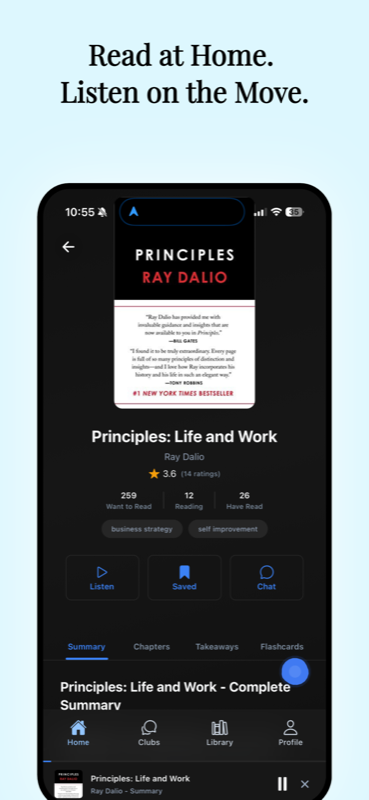
Tap the mic while listening to ask any question. The AI tutor responds in context, understanding exactly where you are in the book. Like having the author sitting next to you.

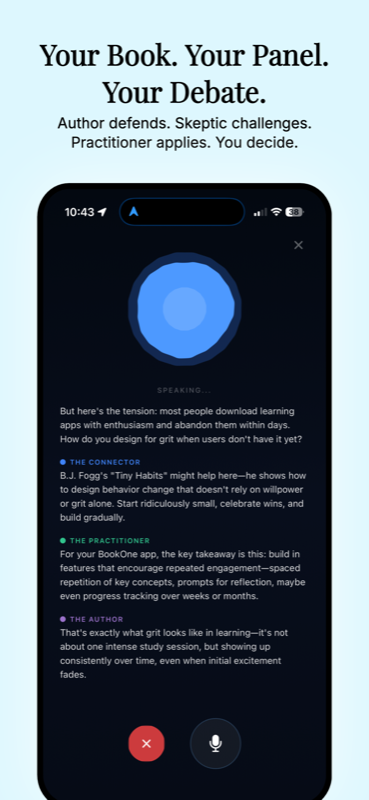
Discuss any book with AI personas who bring different viewpoints. The Skeptic challenges ideas, the Practitioner offers real-world applications, and the Connector ties concepts together.

Listen to AI personas debate the book's ideas in real time. Jump in with your own voice to challenge, agree, or steer the conversation in a new direction.
Auto-generated flashcards use spaced repetition to lock knowledge into long-term memory. Review at scientifically optimized intervals and watch your retention soar.
And more
Built for readers who want to get more from every book they pick up.
Daily reading streaks and progress tracking keep you motivated and consistent.
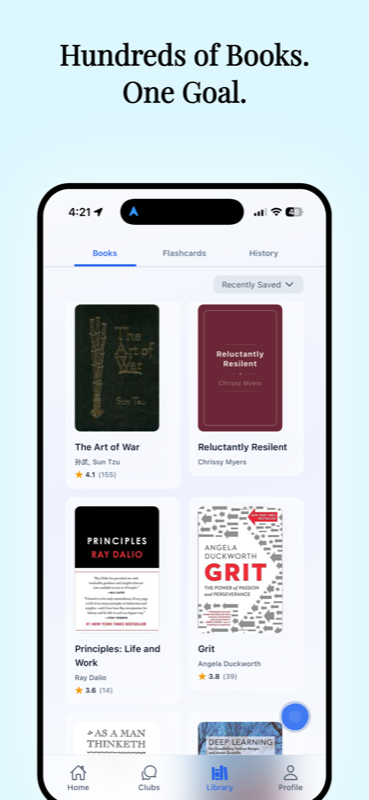
Scan any book, build your personal library, and pick up where you left off.
Tell the app your interests and get customized insights tailored to your goals.
Now available on iOS and Android.
 Scan to download